
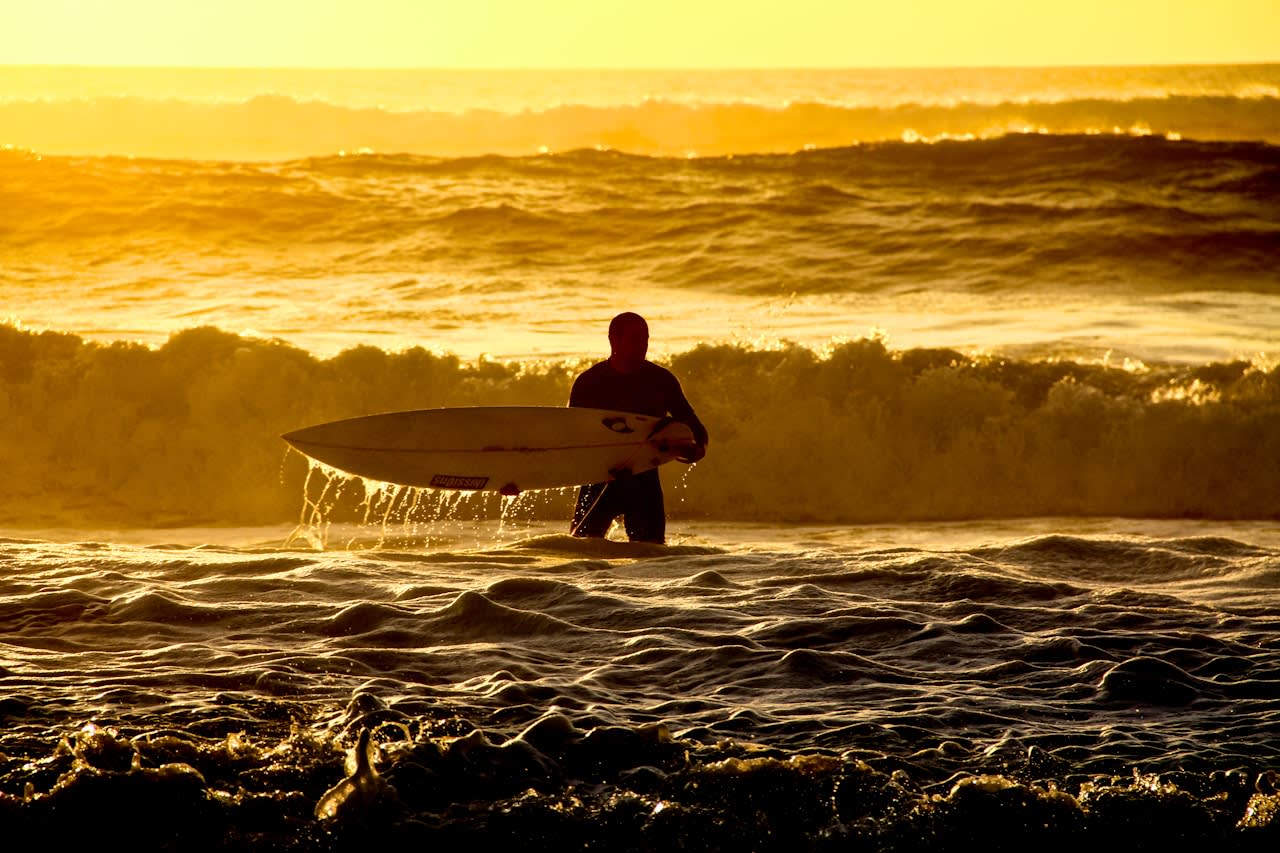
man in black wetsuit holding white surfboard on sea waves during daytime
Basque surfing: a story of water, wind, and identity
From the first boards in the 60s to the world competitions in Hossegor: Basque surfing is a culture in its own right. Swellr tells you its story.
October. The sun isn't even up over Hossegor yet, but the deep sound is already there, that low and repeated rumble that you can feel in your chest as much as you can hear it. The Atlantic is making its presence known. On the beach, the flags in the colors of the sponsors flap in the sea breeze, stretched tight like makeshift sails. A scent of salt, wax, and still-damp neoprene floats in the fresh morning air. Vans with foreign plates, wetsuits drying on open doors, voices from around the world mingle in the village's alleys.
The best surfers on the planet are here, invited by the wave. But in the golden gray of this Basque dawn, someone is already in the water, long before the cameras, long before the crowd. A local. He was here yesterday, he will be here tomorrow and the day after, when everyone else has gone home.
Basque surfing was not born from a marketing plan, nor from an imported trend. It was born from a unique geography and a culture that gave it meaning. To understand what unfolds here every autumn, one must go back to the first boards, to the early pioneers, to the first time the Atlantic changed the course of things on this coast.
When the Atlantic changed everything
The official story begins in Biarritz, in the mid-1950s. The Basque coast is then a bourgeois vacation destination, heir to the Second Empire, with Belle Époque villas and fashionable sea baths. No one yet sees the ocean as a wild playground. No one, or almost no one.
In 1956, an American film crew settles in the region to shoot a movie. Among them is Peter Viertel, a screenwriter and adventurer, who has a surfboard in his luggage. Legend has it that he was one of the first to stand up on a Basque wave, in Biarritz, facing the Rocher de la Vierge, in an Atlantic that was just waiting for it. The act is simple. The break, however, is total.
Geography then enters the scene with an almost indecent precision. The Landes and Basque coast benefits from a full west exposure to Atlantic depressions, a continental shelf that shapes swells over miles of sand, and water tempered by the Gulf Stream, cold but never icy. The conditions are perfect for the wave to become a way of life.
Local pioneers quickly take up the practice. Fishermen, family sons, curious and adventurous spirits who craft their first boards in garages, exchanging rough techniques and jealously guarded spot secrets. In a decade, surfing is no longer American on this coast. It has become Basque.
“We didn’t know what we were doing. We copied what we had seen, we adapted, we failed, we started over. And then one morning, the wave took you as it wanted, and you understood that it was the wave that decided, not you.”
A pioneer of the time
This humility before the ocean, this posture of constant adaptation, permanently distinguishes Basque surf culture from its Californian or Hawaiian cousins. Here, we do not dominate the wave. We negotiate with it.
Hossegor: when a village becomes a world capital
You have to see La Gravière once, really see it, not on a screen, to understand what happened in the 1980s. The beach break at Hossegor is unlike anything else in Europe: hollow, fast tubes that form and close in just a few seconds with a power reminiscent of Pipeline in Hawaii. The sand shifts every winter, sculpting different sandbanks from one season to the next, keeping the spot unpredictable, alive, and demanding.
It wasn't a decision-maker who chose Hossegor. It’s the wave. And that’s why the legitimacy of the place is indisputable. In 1992, the Rip Curl Pro Hossegor joined the WCT calendar, the world surfing championship. A village of 3,500 inhabitants entered the mental geography of surfers from all over the planet.
Every autumn, in October, the same miracle happens: the production trucks, sponsor tents, filming crews, star surfers, and their teams set up along a beach that was deserted just three weeks earlier. The contrast is striking, almost unreal.
On that morning, the one everyone will talk about later, the sky is still purple when Julien steps out of his house, wetsuit pulled up to his waist, board under his arm. He has known La Gravière since childhood. He can read the sets before they arrive, feel the wind shift by the direction of the seagulls. He enters the water at a quarter to six, alone, in the cold of dawn.
“Before the cameras arrive, before the judges settle in, there’s an hour when the wave still belongs to you. It’s for that hour that we live here.”
By nine o'clock, when the production teams start to get busy on the beach, Julien is already out, already rinsing his board. He smiles for no apparent reason. The world capital of surfing has just woken up, and he has already finished his day.
A culture passed down through the water
What sets Basque surfing apart from other surf scenes around the world is not the quality of the waves, even though they are exceptional. It's the way the practice is passed down, from generation to generation, within families.
Here, children are taken to the water at five or six years old, not to make them champions, but because that's just how it is. Fathers calming first fears in the shorebreak, mothers waiting on the sand with warm towels, older brothers explaining how to paddle in sync with the swell. Surfing is not exotic in the Basque Country. It is as ingrained in daily life as Basque pelota or family meals on Sundays.
The Biarritz surf school, one of the oldest in France, embodies this institutionalized transmission. But the real school, the one that matters, is the lineup itself, this circle of surfers sitting on their boards between sets, who all know each other by name, who share forecasts, who debate the best times to hit the water based on the tide and wind.
This collective intelligence of the locals is a valuable and informal resource. It flows through message groups, in exchanges in beach parking lots, in knowing glances between spot neighbors. It has been built over decades of observation, mistakes, and accumulated knowledge, a wild, empirical, irreplaceable meteorology.
It is this transmission, this collective intelligence of the locals, that Swellr is trying to digitize, so that the knowledge of the spots does not remain in the minds of the elders, but circulates, enriches, and serves those who are still learning to read the ocean.
Between preservation and openness: Basque surfing at a crossroads
Success has its downsides. Every summer, the parking lots of the beaches in Hossegor and Biarritz overflow. The spots that locals have surfed in near secrecy for decades are now featured in Instagram stories viewed by thousands. Line-ups fill up with impatient novices, poorly controlled boards, and unspoken codes ignored.
The tension between welcoming and preserving is real, and it’s not new. Basque surfers have always had to deal with the allure of their coast. The scale of the phenomenon has changed. Mass surfing is not cultural surfing, and the distinction is not snobbery: it’s a matter of relationship to the environment, to risk, and to other water users.
The new generations navigate this complexity with natural agility. They surf, film, share, and remain deeply attached to their local identity. The camera does not replace the wave. And the wave has not been tamed.
The real treasure, those in the know understand, is the off-season, that moment between September and November when the last tourists hit the highway and the Atlantic swell settles in for good. The light changes, the beaches empty, the conditions intensify. This is when Basque surfing is most itself: raw, focused, deep. This is when culture reclaims its rights.
Optimism is measured, but it is real. A culture so deeply rooted in geography and in families does not disappear under the influence of a tourist season. It folds back, it waits, it returns, carried by the Atlantic and by the children of the children of the first pioneers.
Back to that October morning. The WCT flags are still flapping in the wind, the production team is waking up, and the commentators are adjusting their microphones. The competition day is about to begin. But on the beach, a man is coming out of the water. Black wetsuit, board under his arm, hair stuck with salt. He smiled even before his feet hit the dry sand.
He caught the best waves of the day. Before anyone else. Before the cameras. Before the judges. Just like always. Just like since childhood.
The Basque surfing culture will exist as long as the Atlantic sends its swells and fathers take their sons to the water on an autumn morning.
Swellr was born from this culture. It aims to be the digital extension of it, for surfers here and those who dream of becoming one. If this story resonates with what you’re experiencing or what you’re searching for, join the Swellr community and help build something that reflects them.
Tu surfes sur la côte Basque ? Rejoins Swellr et partage tes sessions.